The Moss Journal
What Does “Biodegradable” Really Mean for Baby Products?

What Does “Biodegradable” Really Mean for Baby Products?
Parents are increasingly thinking about the environmental impact of the products they buy for their children. And it makes sense: nappies and wipes are used every day, often multiple times a day.
But what does it actually mean when a baby product is described as biodegradable?

Designed to return to nature
Biodegradable materials are capable of breaking down naturally through biological processes rather than remaining intact indefinitely.
For disposable baby products, this distinction matters because the products are designed for a short period of use but traditionally can remain in the environment for a very long time.
Why bamboo?
Bamboo is one of the materials at the heart of the Moss approach.
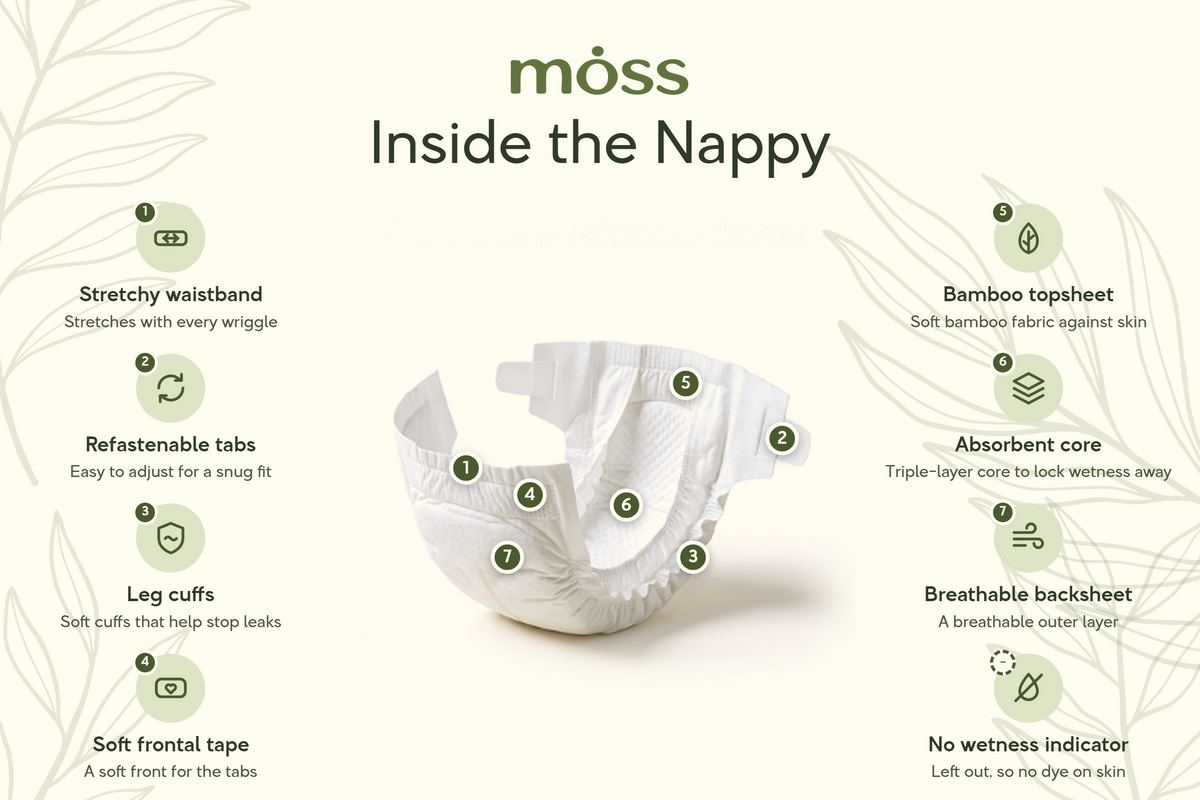
It is a rapidly renewable plant that can grow quickly with relatively low water requirements. Instead of relying on wood pulp for absorbency, Moss uses bamboo as part of its tree-free design.
This allows us to rethink the traditional disposable nappy from the materials upwards.
Tree-free baby care
Traditional paper and wood-based materials ultimately rely on trees.
Moss nappies are designed without wood pulp for absorbency, creating a tree-free alternative built around bamboo.
It's one part of our broader goal: creating baby products that are gentler on the planet without compromising the baby's experience.
Wipes that break down in 133 days
Moss Wipes are made from plastic-free bamboo and are designed to decompose in approximately 133 days.
That is a very different proposition from plastic-based wipes that can persist in the environment for generations.
Baby first, planet always
Environmental considerations should never come at the expense of a baby's comfort.
That's why Moss focuses on both sides of the equation: products need to perform exceptionally well while also being made from more thoughtful materials.
Softness, absorbency and skin comfort come first. Sustainability is built into the design rather than added as an afterthought.
Small choices add up
No parent can solve the world's environmental challenges with a changing table.
But parents make thousands of small purchasing decisions over the course of raising a child.
Choosing bamboo over plastic where possible is one of those decisions.
Choosing products designed to break down naturally is another.
And choosing brands that think carefully about materials, ingredients and production is another.
At Moss, we believe those small choices are worth making.